The Canon
Plate III
The Algebra of Switches
At twenty-one, Shannon showed that switches can do logic, and add.
Paper ground, a warm cream, on Hahnemühle Photo Rag, 308 gsm cotton

Its companion print
Demonstration III: The relay adder Shannon published in 1938, worked out step by step. See it
On the wall

Why it endures
Claude Shannon grew up in a small Michigan town, where as a boy he built model planes, a radio-controlled boat and a telegraph line to a friend’s house half a mile away, strung along a barbed-wire fence. At the University of Michigan he took degrees in both electrical engineering and mathematics, and in a course on symbolic logic he met the algebra George Boole had published in 1854.
In 1936 he went to MIT as a research assistant on Vannevar Bush’s differential analyser, a calculating machine of shafts and gears whose controls ran on relays. Engineers then designed relay circuits, like those in telephone exchanges, by trial and error. Shannon saw that a switch can be closed or open just as a statement can be true or false, so relay circuits obey Boole’s algebra and can be designed and simplified on paper. He wrote this up as his master’s thesis at twenty-one, and among its worked examples was “an electric adder to the base two”, the network drawn on this plate.
The psychologist Howard Gardner later called it “possibly the most important, and also the most famous, master’s thesis of the century”. Relays gave way to vacuum tubes and then to transistors, and Shannon’s algebra carried over unchanged. Chip designers still write circuits in Boole’s algebra, and software simplifies them into logic gates much as Shannon simplified his adder by hand. Eleven years after the thesis, he published A Mathematical Theory of Communication, which founded information theory.
Hang them together
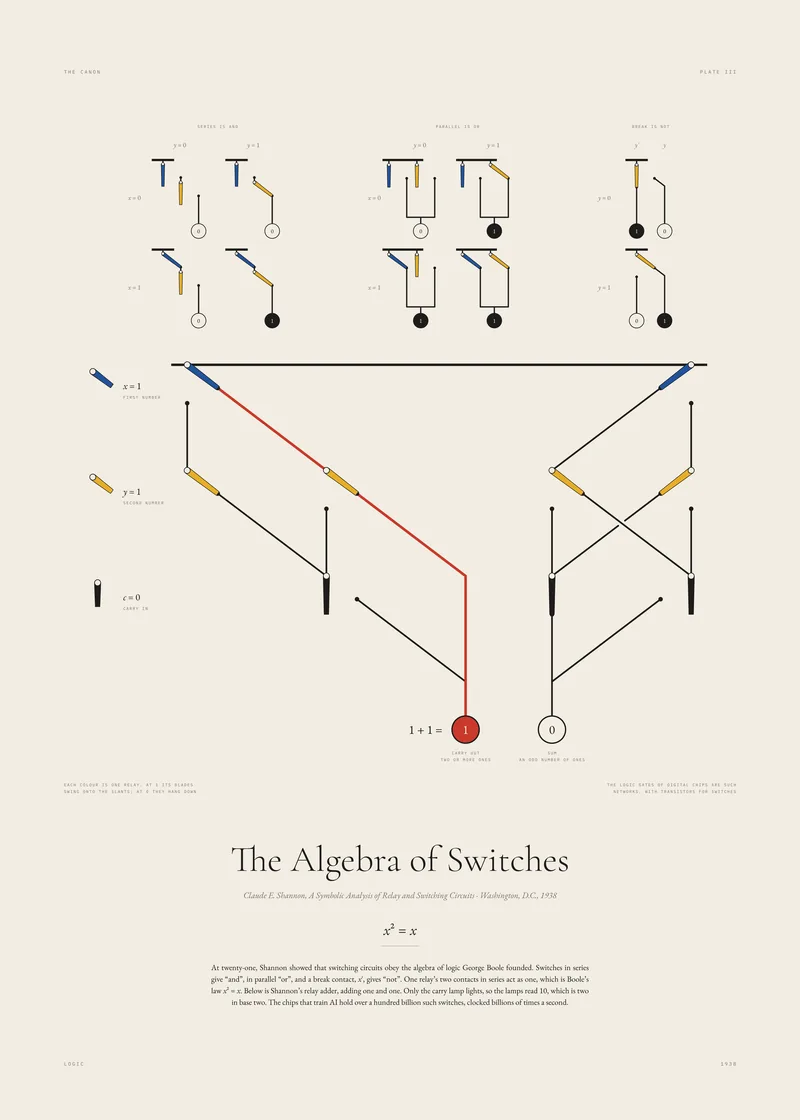
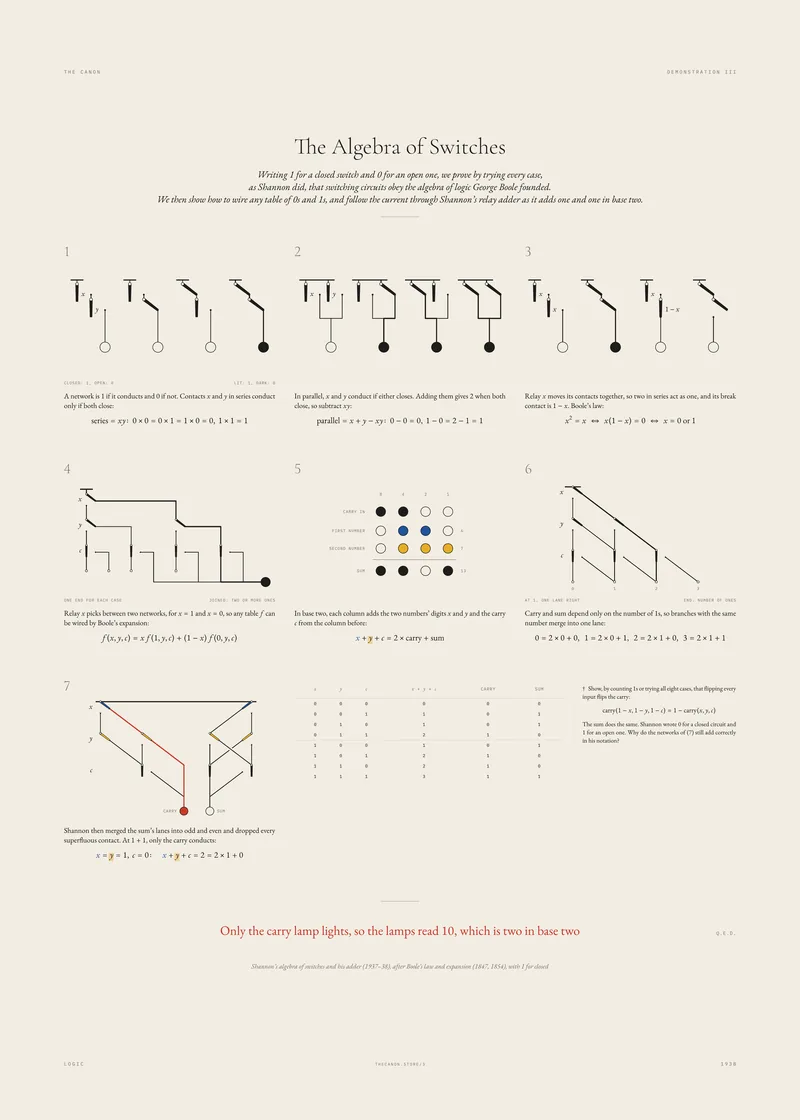
Plate III has a companion print, Demonstration III, which works out how a network of relays adds one and one. Hung side by side in the same size and frame, the two cost 10% less bought together.
Plate III and Demonstration III, Medium, 42 × 59 cm each, in black frames.
The plate
Claude E. Shannon, A Symbolic Analysis of Relay and Switching Circuits · Washington, D.C., 1938
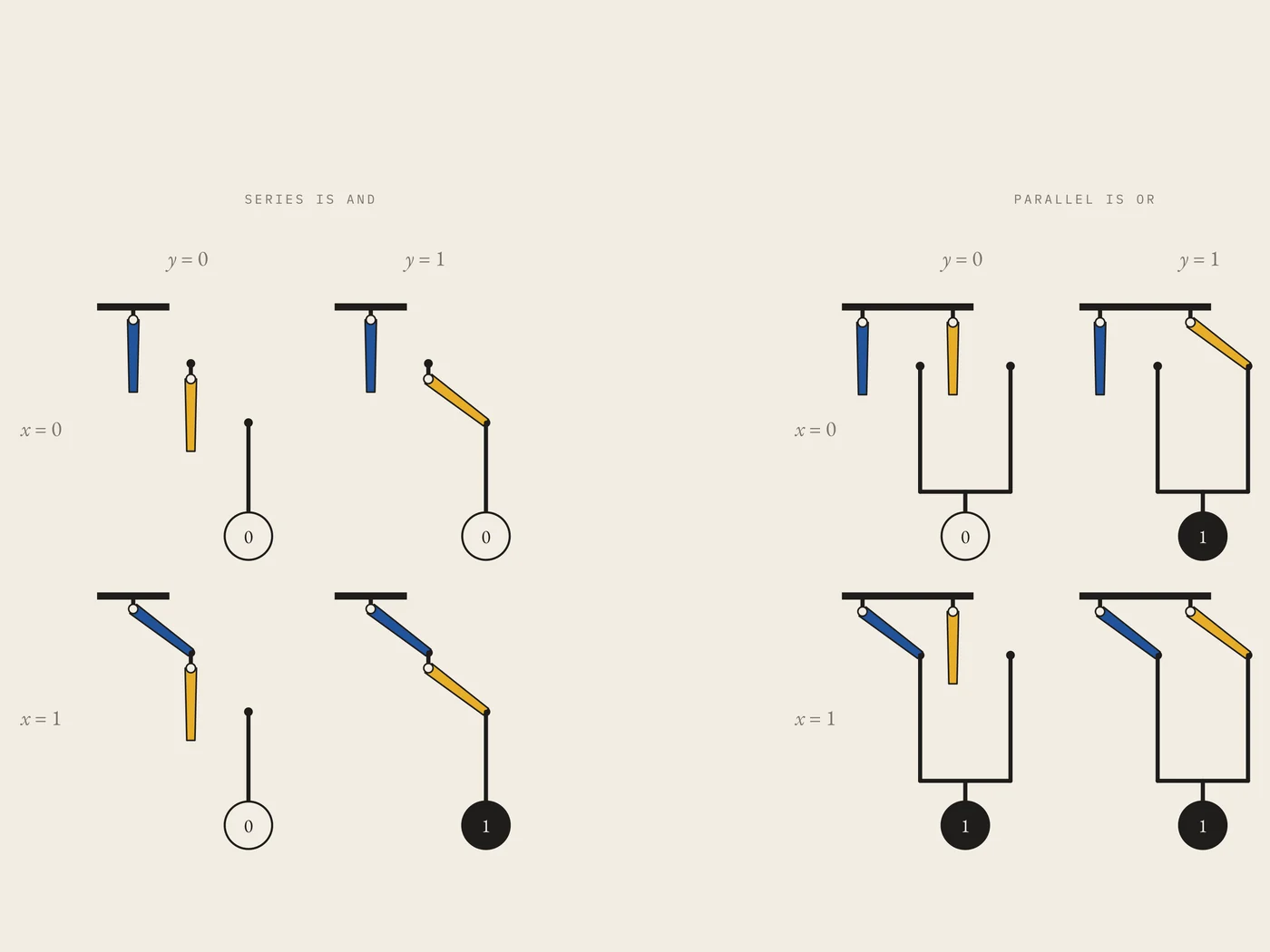
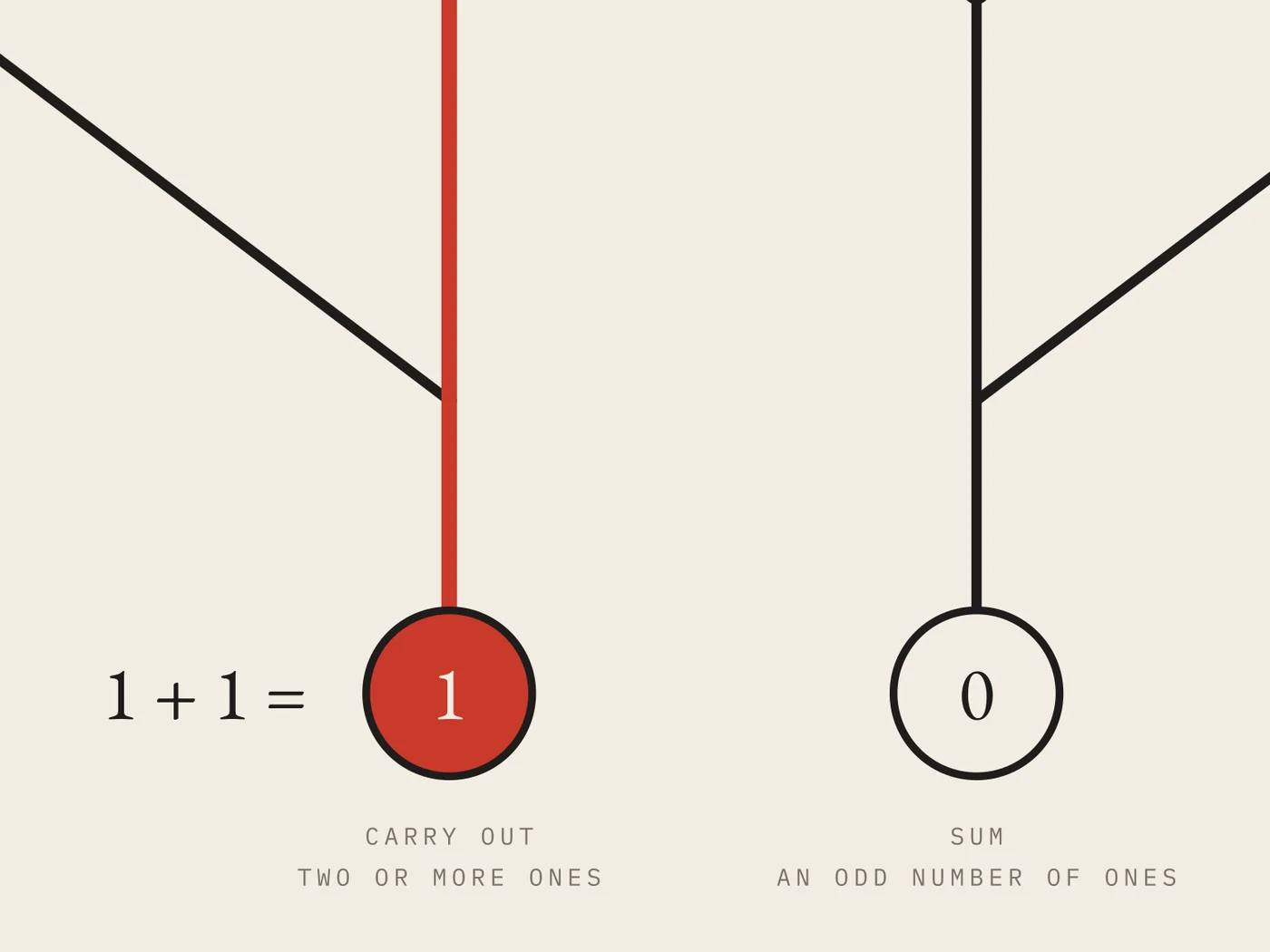
At twenty-one, Shannon showed that switching circuits obey the algebra of logic George Boole founded. Switches in series give “and”, in parallel “or”, and a break contact, x′, gives “not”. One relay’s two contacts in series act as one, which is Boole’s law x² = x. Below is Shannon’s relay adder, adding one and one. Only the carry lamp lights, so the lamps read 10, which is two in base two. The chips that train AI hold over a hundred billion such switches, clocked billions of times a second.
The adder’s two networks are worked out from Shannon’s equations for the sum and the carry. The red path is the one the current takes when the adder adds one and one, and the type is set from the same files that go to the printer.
Sizes and prices
| Size | Unframed | Framed | |
|---|---|---|---|
| Small30 × 42 cm | £50$85 | £140$185 | 297 × 420 mm |
| Medium42 × 59 cm | £95$145 | £225$295 | 420 × 594 mm |
| Large59 × 84 cm | £160$215 | £390$515 | 594 × 841 mm |
| Extra large84 × 119 cm | £285$385 | Unframed only | 841 × 1189 mm |
- Paper: Hahnemühle Photo Rag, 308 gsm cotton, printed as a giclée by theprintspace.
- Printed in: London for the UK, Brooklyn for the US. Small unframed prints travel flat, larger ones rolled in a tube.
- Framed small: A3 frame, glazed with glass.
- Framed medium: A2 frame, glazed with 3 mm acrylic.
- Framed large: A1 frame, glazed with 3 mm acrylic.
- Extra large: unframed only. A0 is a standard frame size.
- Frames: solid wood, finished in black, white or oak veneer, made in Germany. Each comes ready to hang.
- Edition: open, with a certificate. File version v1.